Symmetric Key Algorithms
Symmetric key algorithms use a single shared secret key for both encryption and decryption. The process is straightforward: the sender encrypts plaintext using the shared key, and the recipient uses the same key to decrypt the ciphertext back into plaintext. This makes symmetric encryption fast and efficient, particularly for large volumes of data such as files, database contents, or continuous network streams. It is computationally less demanding than asymmetric encryption, which is why it’s often used for bulk encryption in secure communication channels.
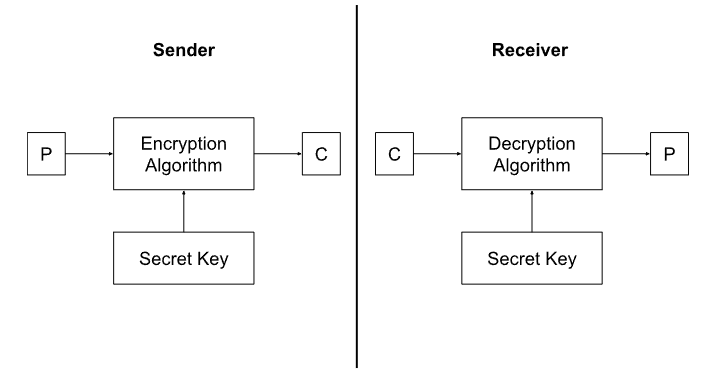 Symmetric Algorithms
However, symmetric key algorithms have several weaknesses:
-
Key distribution: both parties must possess the same secret key before secure communication can occur, and transmitting that key securely—especially over an insecure network—is a challenge.
-
Key management: the problem grows significantly in multi-user environments: in a system with 𝑛 users, secure communication between every possible pair (without others having the same key as a given pair) would require 𝑛(𝑛−1)/2 unique keys. For small networks this is manageable, but at enterprise or global scale, it quickly becomes impractical without an additional mechanism for securely exchanging keys.
-
Refreshing keys is another problem, as every time one participant leaves the group, the key needs to be recreated and shared with all the remaining participants.
-
Non-repudiation is not implemented in symmetric key systems, as the same key is shared and any user with access to the key could have encrypted the message.
Asymmetric Key Algorithms
Asymmetric encryption, also known as public key cryptography, uses a mathematically linked key pair: a public key for encryption and a private key for decryption. No other than the receiver’s private key decrypts the ciphertext encrypted with the receiver’s public key. This public key can be shared openly without compromising security, eliminating the need for secure key distribution channels. This scalability is one of asymmetric encryption’s greatest strengths—each user needs only one key pair to communicate securely with anyone else.
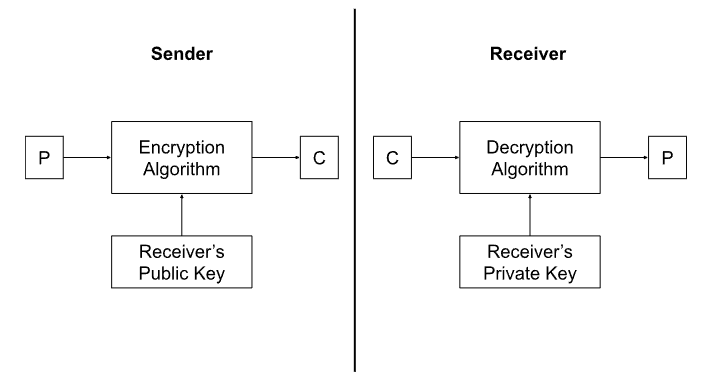 Asymmetric Algorithms
The following is a list of the major strengths of asymmetric key cryptography:
-
The addition of new users requires the generation of only two keys, their private and public keys.
-
Users can be removed far more easily from asymmetric systems, as the only needed action is to revoke the user keys via revocation mechanisms.
-
Key regeneration is only required when a user’s private key is compromised.
-
Assymetric key encryption provides non repudiation in addition to confidentiality, integrity and authentication.
-
No preexisting communication link needs to exist, as key exchange is a simple process and the public key is no secret.
The trade-off, and as such the main weakness, is computational cost: asymmetric algorithms are significantly slower than symmetric ones. For this reason, in practical systems, asymmetric encryption is often used only to exchange symmetric session keys, after which the faster symmetric algorithms handle the bulk of the data encryption.
Hashing Algorithms
Hashing is a distinct cryptographic function that converts data of arbitrary size into a fixed-length output, known as a hash or digest. Unlike encryption, hashing is a one-way function—there is no feasible method to reverse the process and recover the original data from the hash. Cases where a hash function produces the same value for two different methods are known as collisions, and the existence of collisions typically leads to the deprecation of a hashing algorithm.
Hashing is used for data integrity checks, password storage, and digital signatures. While it does not provide confidentiality, hashing is critical for verifying that data has not been altered in transit or storage.